Sunday, September 29, 2013

Forest lights Die Licht durch den Wald

Forest lights Die Licht durch den Wald
The morning sun danced playfully through the bright green leaves high above my head;
only the sound of a gentle breeze, a distant bird calling out, and rustling of critters under a carpet of fallen foliage.

Trying to channel Thoreau along this remote forest path, I whispered softly, "I went to the woods because I wished to live deliberately, to front only the essential facts of life, and see if I could not learn what it had to teach, and not, when I came to die, discover that I had not lived..."

Sounding silly I marched deeper along the Natchez Trace with my copy of Walden, seeking solitude and elusive peace to quiet the spirit of a suburban dad. How different this world is from incessant SmartPhone messages, Facebook updates, and media saturation; a constant "noise" flooding our lives with satellite, cell phone, radio waves -- audible and otherwise.

I heard a subtle patter accompany my stroll, lightly tapping the dead leaves that lined my path. What invisible creatures could make such sounds? Is the speed or force of my gate causing this phantom rustle?

As I bent down to investigate, I found a forgotten reality -- a place rarely visited by distracted people like me; a place I often spent hours as a child, but only moments in the last decade. I saw spiders -- hundreds of those "grand-daddy long legs" scurrying with fantastic agility along the ridges and gullies of an infinite leaf-scape.

Moving like creatures from some Tim Burton film, each step tapping out a slight sound of light drizzle, these marvelous spiders were my sojourners along the path. Where were they going in their daily commute? Afraid of the bipod giant in khaki cargo shorts?

And so my thoughts reflected on a recent conversation on the "Philosophy of Mind", a discipline devoted to issues such as how the brain interacts with the mind, whether thoughts are just mental constructs of the physical brain, theoretically measurable in chemical formulas, and so on. If the mind is indeed a separate entity of the brain, then do apes have minds? Do dogs and cats? Do spiders? And if so, what do they think about?

I found a small patch of moss growing thick and soft, sending fragile 3-inch shoots of yellow buds toward the canopy of life far above, yearning for a little more love from the sun. Deep in this micro-forest of moss, five or six ants investigated their surroundings as I did mine.
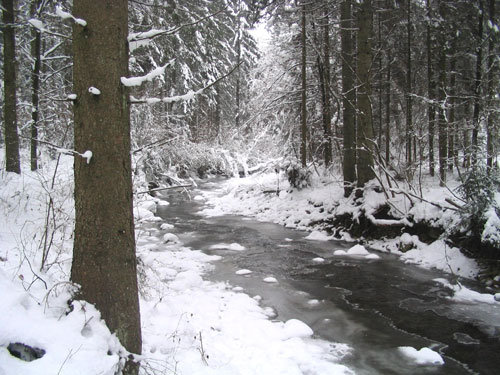
Forest lights Die Licht durch den Wald


My prodding finger softly depressed a spot on the small mossy hills, and I was suddenly discovered. One of the ants became keenly aware of my presence and began making its way toward my finger. When I withdrew, the excited little arthropod made a rush for my feet.

Would this ant defend its family, its forest, its honor in the face of certain death at the hands (or shoes) of a giant? Yes -- it would.

Although I declined his offer to wrestle and made my retreat with haste, I began to wonder -- does this ant have a mind? Perhaps not one to contemplate astrophysics or Marxism or the World Cup... but perhaps duty and architecture and a sense of sacrifice; how noble are these smallest of creatures.

wald fuer Winter
"Shams and delusions are esteemed for soundest truths, while reality is fabulous.... When we are unhurried and wise, we perceive that only great and worthy things have any permanent and absolute existence, that petty fears and petty pleasures are but the shadow of reality." - Thoreau, Walden

My two hours in the woods left me wanting. I enjoyed a brief respite from the pressures and distractions of Thoreau's "shadow of reality" and realized I need more time for botany, for breathing, for vainly considering the life of an ant and the lilies of the field as a worthy exercise in itself.

Monday, September 23, 2013

Light rails Leichtbahn destructure in mapping video

Light rails Leichtbahn destructure in mapping video
Light rail Leichtbahn or light rail transit (LRT) is a form of public transport using a steel-tracked fixed guideway that operates primarily along an exclusive right of way and has vehicles capable of operating as a single unit or as multiple units coupled together

Lightrails' is a light sculpture with the intention to re-define and re-interpret the exhibition room. An easy but effective mapping technique was used to create seamless projections on both sides of the object. Light-beams were triggered by the visitors and ran through the room, following the surface created by the sculpture. Each "reflection" of the light-beam was accompanied by sound. The speed and brightness of the beam was directly influenced by the force the
Light rails Leichtbahn destructure in mapping video
visitors used when triggering the beam stepping on pedals on the floor. This also influenced the volume of the sound-effects. The audio signal was played back on a surround sound system that allowed a spatial positioning of the sounds and created a truly immersive experience.ounds to create a truly immersive experience.

More information about the video film files channal,welcome to browse the related blogger http://videofilmfiles.blogspot.com

Tuesday, September 17, 2013

projection mapping on Manhattan Bridge stop motion animation video

projection mapping on Manhattan Bridge stop motion animation video
Manhattan Bridge,suspension bridge over the East River connecting southeastern Manhattan with western Brooklyn in New York City.
The bridge first opened to traffic in 1909, eight years after construction started.

The bridge is newer than the Brooklyn Bridge and the Williamsburg Bridge, the other two suspension bridges that span the East River, and often acts as an alternate route due to its proximity to the Brooklyn Bridge. The Manhattan Bridge, which is 6,855 feet (2,089 metres) long, consists of a double-deck motorway with four lanes on top and three lanes on the bottom that are designed to change direction when necessary to assist traffic flow. In addition to cars, the bridge carries four subway lines, a pedestrian lane, and a separate bikeway. Nearly 80,000 vehicles and more than 320,000 people use it (via public transportation) each day.

Construction began on the bridge in 1901 under the instruction of the New York City Department of Bridges commissioner Gustav Lindenthal and the chief engineer R.S. Buck. Just three years later, however, local politicking was responsible for the pair being replaced with George E. Best and Othniel Foster Nichols, respectively. The bridge design was based on deflection theory, a new concept at the time that was developed by Joseph Melan and applied to the bridge by the chief engineer Leon Moisseiff. This design saved in cost, material, and
projection mapping on Manhattan Bridge stop motion animation video
construction time. The bridge was officially opened to traffic on Dec. 31, 1909. Renovations in 1940 revealed significant wear on the structure, with the subway trains partly responsible for the wear. Those trains, upon entering the bridge at the same time from opposite sides, would cause the bridge to shift up to 8 feet (approximately 2.5 metres). Additional renovations were undertaken in 1978. Since then the Manhattan Bridge has been featured in movies, has undergone regular repairs and retrofitting, and remains one of the most graceful bridges in New York City.

For more information about various stop motion videos generated by the projection welcome to browse our blogger http://videofilmfiles.blogspot.com

Sunday, September 8, 2013

Icebook first projection mapping video from Pop-up book in the world

Icebook first projection mapping video from Pop-up book in the world
The Icebook - the world's first projection mapped pop-up book. An exquisite experience of fragile paper cutouts and video projections that sweep you right into the heart of a fantasy world. It is an intimate and immersive experience of animation, book art and performance.

For more information about various stop motion videos generated by the projection welcome to browse our blogger http://videofilmfiles.blogspot.com

Wednesday, September 4, 2013

Best Short film plastic bag Plastikbeutel

Best Short film plastic bag Plastikbeutel


Ostensibly, Plastic Bag is an environmental film. That might raise a red flag for some, for whom the preachiness of "message documentaries" screams "BORING". But despite the socially conscious message lurking within the film it is resolutely narrative, and, within that category, dramatic and deft too, in its dramatization of the life cycle of a disposable commodity.

The film follows a wayward plastic grocery bag: sentient and voiced by Werner Herzog to amazing effect, as it searches for meaning to its existence. It is a heavy subject—existential angst—and in the form of a plastic bag's personification, definitely absurd. However for the most part the film takes itself and its concept seriously, albeit with occasional breaks for wry humor. The result is a film that is a success as education and entertainment; one that musters a startling amount of pathos from its subject and a surprising amount of empathy from its audience.
Best Short film plastic bag Plastikbeutel

The best entry of Future States, a whole series of films commissioned by ITVS, Plastic Bag is a confident and polished piece of art that successfully navigates these two simultaneous threads: the interior and the exterior, humanity and nature, the particular and the environmental. It accomplishes both these angles with aplomb in a quite moving whole. I very much like this film and hope you take the time to enjoy it as well.

Thursday, August 29, 2013

Great Animation "will" about the wish from one father in the 9/11 accident

Great Animation "will" about the wish from one father in the 9/11 accident
The video "WILL" is a Great Animation about the wish from one father in the 9/11 accident,mirroring a tender story about the love between the fater and his daughter.

There are rays of sunshine emanating from California that are beaming over the online video world.
Streams of new animated shorts have been quickly arriving to virtual inboxes heralding the arrival of the year end CalArts projects. I've been watching many of these films, and want to highlight what to me is easily the standout of this year's crop. Unlike many of its brethren, this film is not full of sunshine however, it is deeply sad. It is a tearjerker—a deeply moving piece that is as devastating as it is beautiful. Using exquisite art direction and brilliant sound to heighten an already emotional subject, will is a tender, indeed heartbreaking, treatise on love, longing and loss.

It is a parent/child story, bookended by voicemail messages. In the chaos between the first World Trade Center crash and the second, a father wishes to connect with his daughter. Looking back over clippings of the disaster, a scrapbook of rememberence, the daughter wishes to turn back time. It is not strictly speaking a factual tale, yet, is there any doubt that among the thousands that lost their lives and for their families left behind that the story dramatized is "true"?

The film revolves around a central metaphor, the girl playing with a yo-yo given to her by dad. The falling of yo-yo mirrors her father falling out the window of the tower. A yo-yo however, can be pulled back up. If only her father's circumstances were the same. Into her imagination she retreats: the rising yo yo peeling back time, his morning routine in reverse until she can be safe in his arms again.

Reverse time is not a new trick,the video might be most famous to use it in an extended way, but to pair the technique it with circumstances so dramatic is bold and effective. Overall Song's juggling of time is exceptional. He uses a stellar match-on-action cut to transition between the present day and the flashback to the father from that morning. Color is also employed effectively to differentiate between the two timelines: burnt orange tones for the father, reflective of his fiery conclusion, cool greens and browns for the daughter.
Great Animation

Animated in a trendy minimalism, this decision helps the film greatly as well. In the ten year's since 9/11 there has been much written about the lack of great art born from the disaster. I feel it is difficult for narrative artists to touch on both the specificity of the event and it's overwhelming magnitude. But the less specificity in representation, the more empathy a drawing is able to engender. A story about a single girl, the film nonetheless feels more universal than that.

In a final note, the sound, designed by Paul Fraser and music performed by Julian Kleiss, is exceptional. Spare, like, the animation, they complement the film well. The most obvious and effective element however is the otherworldly, high pitched sounds that come in during the film's second half. A simple audio trick of playing sound in reverse, they mirror the action of the film perfectly, as well as well as the inhuman power it would take to move the world backward. An impossible wish, but one wish the girl can't be blamed for envisioning all the same.

Saturday, August 10, 2013

Queen Elizabeth Prize for Engineering Prix de la Reine Elizabeth pour les sciences de l'ingénieur

Queen Elizabeth Prize for Engineering Prix de la Reine Elizabeth pour les sciences de l'ingénieur
Five engineers who created the Internet and the World Wide Web have together won the inaugural £1 million Queen Elizabeth Prize for Engineering for their innovations,
which have revolutionised the way we communicate and enabled the development of whole new industries. Today a third of the world's population use the Internet and it is estimated to carry around 330 Petabytes of data per year, enough to transfer every character ever written in every book ever published 20 times over.

Engineers Robert Kahn, Vinton Cerf, Louis Pouzin, Tim Berners-Lee and Marc Andreessen were announced as the winners by Lord Browne of Madingley, in the presence of HRH The Princess Royal, at the Royal Academy of Engineering on 18 March 2013. The winners will come to London in June for the formal presentation of the prize by Her Majesty, The Queen.


The art of engineering lies in the efficient combination of technologies to deliver the most meaningful results for society. The international team of judges for the Prize considered that these five outstanding engineers epitomise this approach in the way that they designed and built the Internet and the Web.


Lord Broers, Chair of the Judging Panel for the Queen Elizabeth Prize for Engineering, says: "Engineering is, by its very nature, a collaborative activity and the emergence of the Internet and the Web involved many teams of people all over the world. However, these five visionary engineers, never before honoured together as a group, led the key developments that shaped the Internet and Web as a coherent system and brought them into public use.

Queen Elizabeth Prize for Engineering Prix de la Reine Elizabeth pour les sciences de l'ingénieur

"We had originally planned to award this prize to a team of up to three people. It became apparent during our deliberations that we would have to exceed this limit for such an exceptional group of engineers."


The Queen Elizabeth Prize for Engineering Foundation has overall responsibility for the prize and the board of trustees is chaired by Lord Browne of Madingley. The day-to-day running of the prize is managed by the Queen Elizabeth Prize team at The Royal Academy of Engineering.